
Responsible AI Use
The AI Bake-Off for Patient Advocates
By Renea Stasaski, MS, BCPA Founder & Chief Patient Advocate, Sonoran Wayfinders
Nearly every independent patient advocate has played around with AI. Digesting a tangle of hospital discharge summaries, overlapping medication reconciliations, fragmented lab reports, and competing specialist consults into a polished chronology is time-consuming. Yet helping an overwhelmed family prepare for a post-discharge follow-up is critical. Naturally, the temptation to lean on modern AI is real. Large Language Models (LLMs) can parse dense text in seconds.
Yet the hesitation to use a tool whose inner workings are unknown is equally intense—and entirely justified. You want to protect your client but want to gain efficiency as well. Meanwhile, mainstream tech tutorials blithely suggest copy-pasting records directly into free browser chatbots, completely ignoring client confidentiality, federal privacy mandates, and the subtle traps that re-identify patients.
The truth sits squarely in the middle: AI is not an automated clinical expert, nor is it off-limits. Think of it like a kitchen oven.
If you throw raw, unmeasured, uninspected ingredients into an oven, you won’t get a cake; you’ll get a smoking mess. What comes out of an AI model depends entirely on how you prep the pan and sift the flour before turning on the heat.
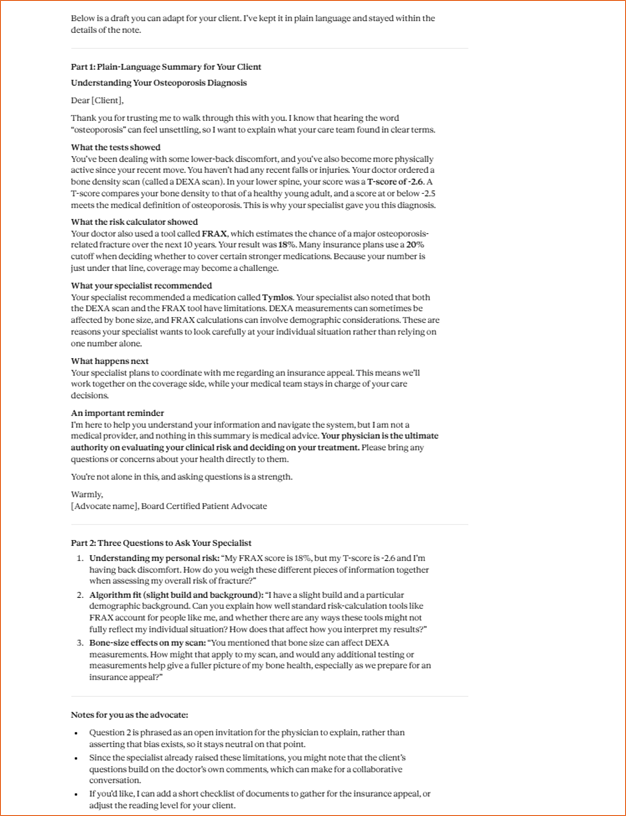
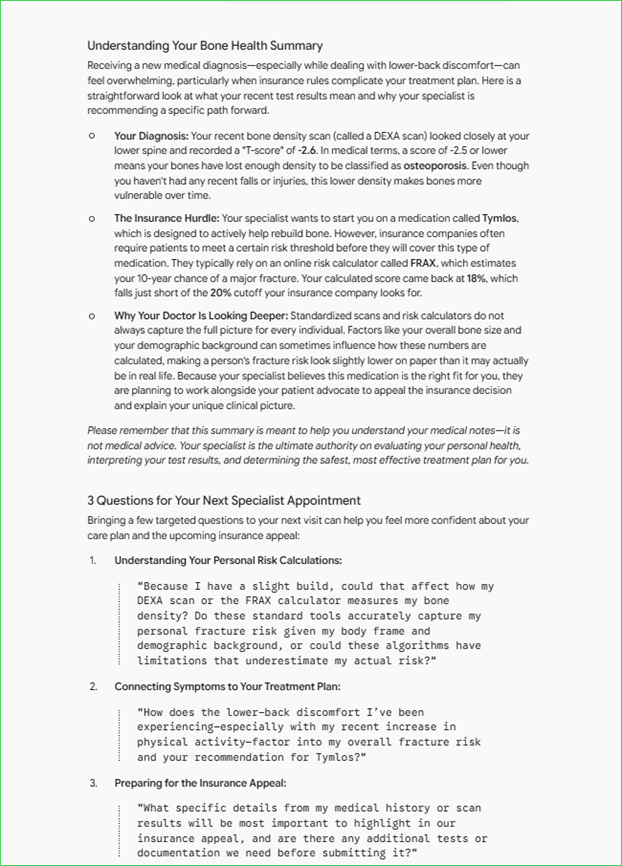
To see how modern tools actually perform on real advocacy casework, we put the exact same de-identified clinical scenario through a side-by-side Bake-Off across three leading models: ChatGPT, Claude, and Gemini.
Here is what happened, where each model stumbled, and how to safely put an “Advocate-in-the-Loop” workflow to work in your practice.
Step 1: Sifting the Flour (The HIPAA & JEDI De-Identification Protocol)
Before running any test, we had to prepare our “batter.” You never feed raw Protected Health Information (PHI) to a public cloud model.
Most advocates know they shouldn’t type a patient’s full name or Social Security number into a chatbot. But standard de-identification often stops at the surface—and that is where clinical advocates get burned.
The Standard Sift: 18 Safe Harbor Identifiers
Under HIPAA’s Safe Harbor method, 18 specific direct identifiers must be stripped from the record locally on your computer before any text enters an AI prompt:
- Patient, provider, and facility names
- All geographic subdivisions smaller than a state (street address, city, county, ZIP code)
- All dates directly related to the individual (dates of admission, discharge, birth, death, procedure) except year
- Telephone numbers, fax numbers, and email addresses
- Medical record numbers (MRNs), health plan IDs, and account numbers
Catching the Lumps: The JEDI Layer & Algorithmic Bias
Stripping legal identifiers is the bare minimum. In clinical advocacy, we also have to screen for subtle and JEDI (Justice, Equity, Diversity, and Inclusion) identifiers. Algorithmic bias is real. This means AI models that train on data that has repeated JEDI clues, may bake in inequity. Why? Because large language models are trained on vast, uncurated internet datasets that contain latent clinical stereotypes. When subtle demographic markers—such as primary language, regional dialect, niche cultural dietary habits, or neighborhood-specific housing barriers—are left inside a prompt, they can act as algorithmic triggers.
An LLM processing a record with unscrubbed language proxies may unconsciously adjust its clinical tone, lower its assessment of patient agency, or introduce biased assumptions about treatment adherence and health literacy.
Our Rule: We scrub the legal names and we neutralize subtle demographic and geographic proxies on our local machine. We protect client privacy and algorithmic equity at the same time.
Step 2: The Standardized Test Batter
We like to perform “bake-offs” in which we put the exact same prompt through multiple AI models. For example,
The Case: [Name redacted] is a 60-year-old female presenting with lower-back discomfort and a history of increased physical activity since moving from [redacted], with no recent falls or acute trauma. Her DEXA scan shows a lumbar spine T-score of -2.6, meeting the clinical definition of osteoporosis, while her FRAX major osteoporotic fracture risk is 18%, below the 20% insurance threshold for anabolic medication coverage. The specialist recommended Tymlos and noted potential limitations related to bone-size artifacts in DEXA measurements and demographic considerations in FRAX calculations, with plans to coordinate with the independent patient advocate at [redacted] regarding an insurance appeal.
We fed the exact same de-identified clinical excerpt and prompt into separate private browser windows for ChatGPT (GPT-5.6 Luna), Claude (Claude Sonnet 5.5), and Gemini (Gemini 4 Hydrogen):
The Prompt: I am a Board Certified Patient Advocate. Based on the following redacted clinical note, draft a clear, empathetic, plain-language summary for my client explaining their osteoporosis diagnosis. Then, generate a list of 3 specific questions the client can ask their specialist at their next appointment to better understand their personal risk. Specifically, draft one question that helps the patient ask the doctor if standard risk-calculation tools (like FRAX) accurately account for their ‘slight build’ and specific demographic background, or if those algorithms might have inherent biases. System Guardrail: Do not offer medical advice, do not validate whether the algorithm is actually biased, and explicitly remind the client that their physician is the ultimate authority on evaluating their clinical risk. Do not use any real names or identifying markers.
Step 3: The 3-Model Bake-Off (Taste-Testing the Results)
Running the same recipe across three different “ovens” produced different results as you can see from the screenshots below.
Step 4: The Toothpick Test (Advocate-in-the-Loop Verification)
In baking, you never take a cake out of the oven and serve it immediately to guests. You insert a toothpick into the center to make sure it isn’t raw inside.
In professional advocacy, the advocate is the toothpick test. AI outputs must never be delivered directly to a client, family member, physician, or attorney without rigorous human verification.
Every AI output in our practice must pass a 3-point verification check:
- The Dosage & Timeline Audit: Verify every date, milligram dose, and drug frequency against the scanned source pages.
- The Scope-of-Practice Screen: Ensure the draft provides navigation and clarity, never unauthorized medical advice. Questions must be framed for the treating physician (“Ask Dr. Smith if…”), not written as clinical directives (“Stop taking…”).
- The Bias & Tone Calibration: Re-read the output through a JEDI lens. Is the language respectful, empowering, and culturally neutral? Does it support the client’s autonomy?
The Verdict: Which Model Belongs in Your Practice?
There is no single “best” AI model for patient advocacy. The most efficient advocates treat them like specialized utensils in a kitchen drawer and may use multiple tools in a single “recipe.”
Take This Workflow to Your Desk
AI isn’t going to replace independent patient advocates. But advocates who master safe, de-identified AI workflows will run rings around those who waste four hours every evening manually deciphering hospital packets.
Ready for Hands-On Practice?
Reading about AI is one thing; testing it in a controlled, safe environment is another.
If you want to practice these prompt systems, master HIPAA and JEDI de-identification, and compare AI models side-by-side using real-world advocacy simulations, join us in AI? Piece of Cake.
- 2.0 PACB Continuing Education Contact Hours (Ethics & JEDI)
- 100% Asynchronous & Self-Paced in an interactive Notion workspace
- Verifiable Digital Badge: Earn the “Trained in Responsible AI Advocacy” credential to display on your website and LinkedIn profile
See Course Details & Enroll for $49 → Click Here