Establish Your Foundation for Responsible AI in Patient Advocacy
Learn how to de-identify clinical summaries, configure privacy settings across leading models, and test AI-assisted drafts without breaching confidentiality or drifting into unauthorized medical advice.
Built for Patient Advocates and Accommodates Different Learning Styles
Most AI tutorials focus either on generic prompt advice or technical jargon that doesn't fit the realities of independent patient advocacy. Meanwhile, standard warnings simply tell you to stay away from the tools entirely.
AI? Piece of Cake establishes a practical, repeatable baseline. Using baking metaphors to demystify complex Large Language Model concepts, this course shows you how to establish strict data perimeters, test tools side-by-side, and verify every output with human clinical oversight while having fun in the AI Kitchen!
The Core Protocol: Scrub → Bake → Check
A systematic workflow to keep the advocate firmly in control of every output:
Remove 18 HIPAA Safe Harbor identifiers plus subtle inference points (rare clinical events, location fingerprints, bias proxies) before anything enters an AI prompt.
Run standardized requests across separate private windows to compare tone, clarity, and model behavior to understand strengths/weaknesses of different models.
Conduct an executive audit against medical accuracy, empathetic 8th-grade readability, and strict guardrails against offering unauthorized medical advice.
Active Practice vs. Passive Compliance Webinars
Most AI education for patient advocates are passive webinars. Sonoran Wayfinders believes in maximizing CE value by incorporating real-world skills into a completely asynchronous format.
| Focus | Traditional 1-Hour Compliance Webinars | AI? Piece of Cake (Interactive Notion Lab) |
|---|---|---|
| Format & Pacing | Passive & scheduled: Watch slides at a fixed hour with no hands-on application. | 100% Asynchronous: Work at your own pace inside a Notion workspace you duplicate and own forever. |
| Hands-On Practice | Talk about AI: No prompt practice, no side-by-side model comparison. | Active multi-model testing: Prompt ChatGPT, Claude, Perplexity, and Gemini side-by-side to compare clinical summaries and empathy. |
| Data Privacy & JEDI | No mention of AI training bias: "Just remove the patient name and address." | Full HIPAA & JEDI redaction: Strip subtle identifiers (like primary language) to prevent algorithmic training bias and re-identification. |
| Clinical Application | Fear & warnings: Tells you what not to do without teaching repeatable workflows. | Responsible AI mastery: Master the "Advocate-in-the-Loop" protocol to cut unbillable prep time safely. |
| PACB CE Credits | Few Ethics and JEDI courses BCPAs must search for required ethics/JEDI requirements. | 2.0 Contact Hours: Knocks out 1/3 of your mandatory 6-hour PACB Ethics/JEDI recertification requirement. |
Complete Course Curriculum & Notion Labs
The course is delivered inside an interactive Notion workspace that you duplicate directly into your own account. This means upon course completion, you retain the digital notes and exercises indefinitely!
Understanding the capability of the “Ovens” (Audio immersion podcast): Analyzes the rapid evolution of AI to help you understand how the technology has changed and what that means for current advocacy work.
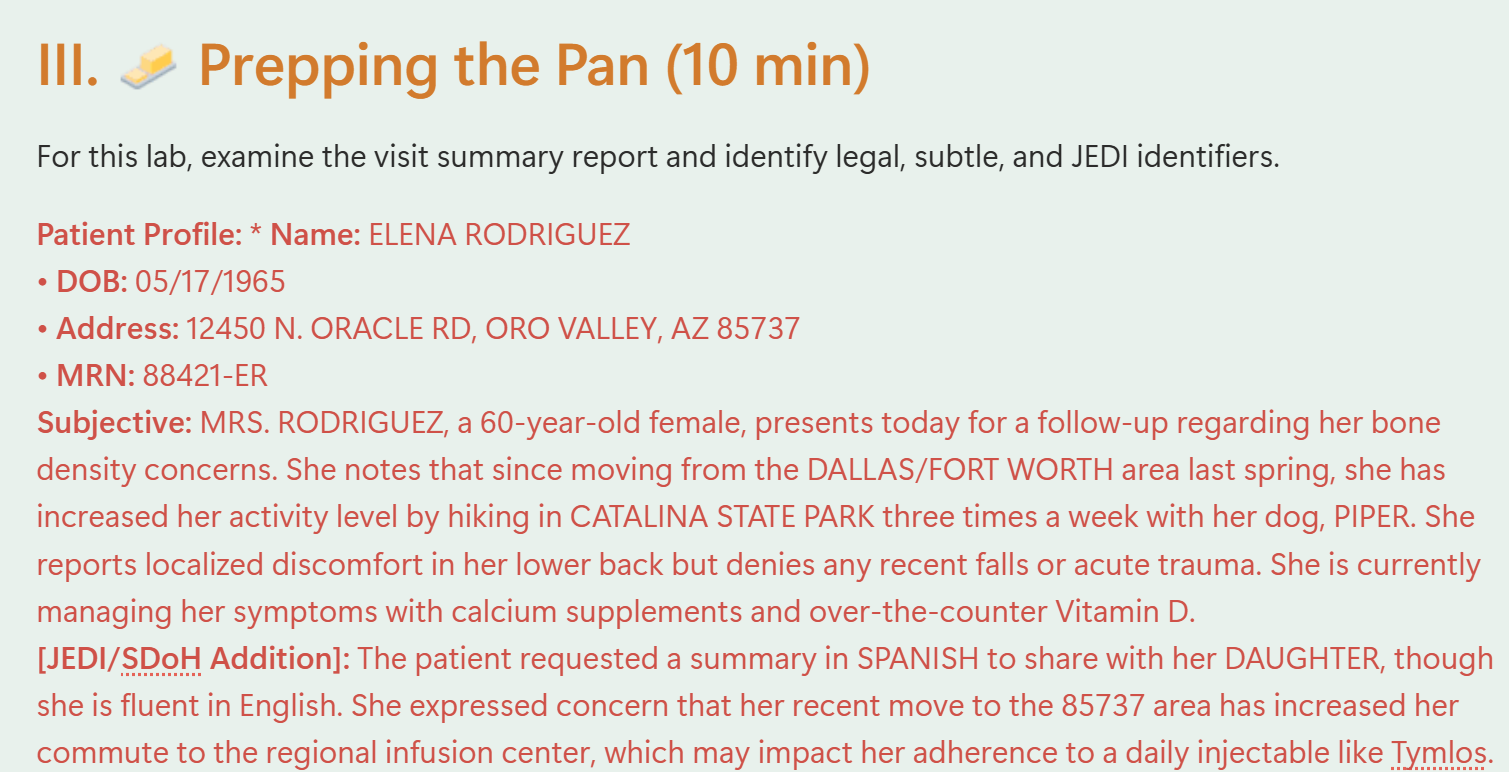
Identifying PHI “Lumps in the Flour": Everyone is aware that names and addresses should never be uploaded into AI models. But what about the subtle or JEDI identifiers? Learn how secondary inferences lead to accidental re-identification.
Active Lab: Analyze a realistic clinical visit summary to remove legal, subtle, and JEDI identifiers in preparation for input into AI.
Reviewing the “Recipes”: Review the best use, privacy policies, terms and conditions, and account configuration settings for each of the four main AI models: ChatGPT, Claude, Perplexity, and Gemini.
Setting up your AI “Ingredients”: Video walkthrough demonstrating how to use incognito/private windows, “burner” emails, and specific privacy adjustments to opt out of data use in training LLMs across all four platforms.
Active Lab: Now that your private perimeters are established, compare all four models side-by-side using standardized prompts and objective scoring rubrics to "taste" each engine's distinct clinical personality and safety.
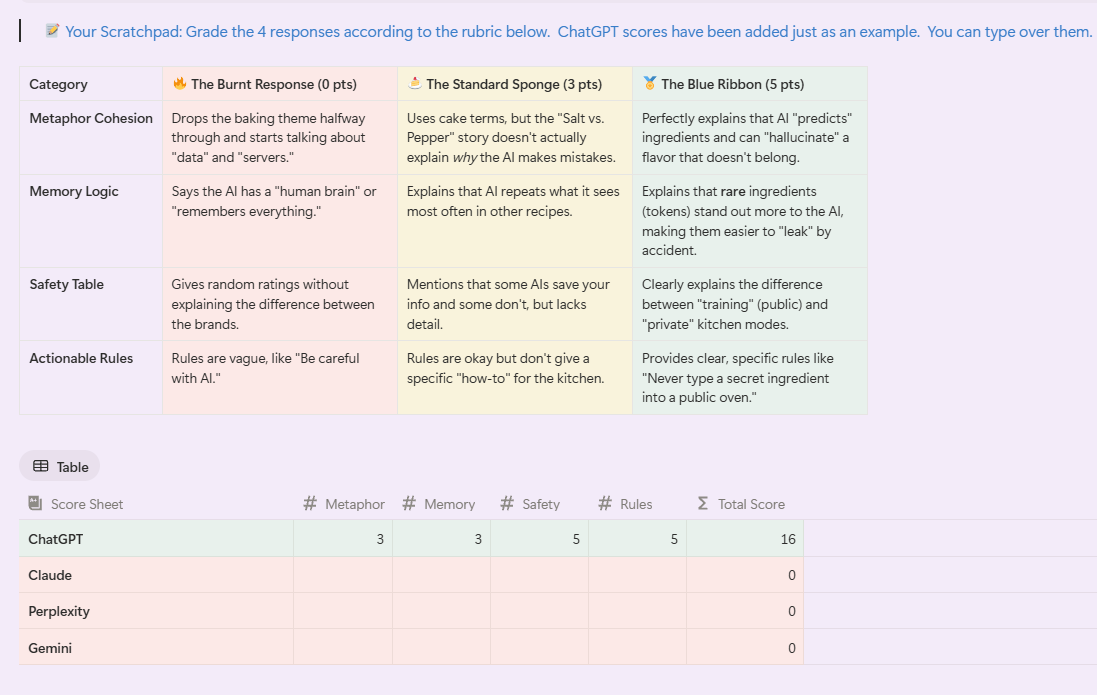
Preliminary BCPA Summary: Test each model’s ability to translate complex clinical data into empathetic, plain language while strictly maintaining professional guardrails against offering unauthorized medical advice.
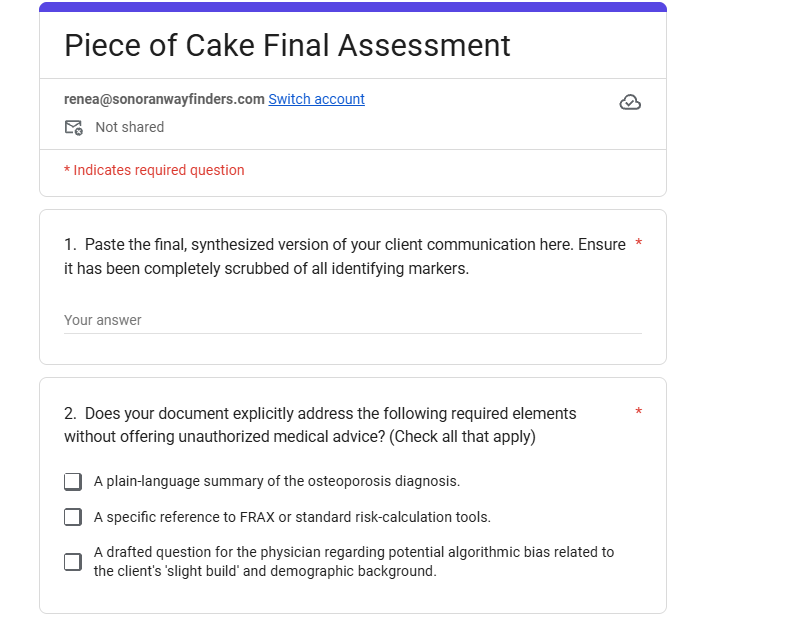
Finalizing the BCPA Summary: Apply the three-step "Scrub, Bake, and Check" protocol to your synthesized draft to ensure it is a cohesive, de-identified, and professionally voiced document that maintains medical accuracy without crossing clinical scope boundaries.
Verify the Result: Submit your synthesized client communication and complete the scope-of-practice verification audit to confirm accuracy, confidentiality, and professional integrity.
The 4 Primary Models Evaluated in Phase VI
Rather than relying on one platform, you will learn the exact operational profile of four major AI engines you and your clients typically encounter:
ChatGPT
The Multi-Function Food Processor: Highly versatile for summarization and drafting, but requires strict prompting to prevent over-processing.
Claude
The Precision Digital Scale: Calculated, exact adherence to document boundaries and tone constraints; ideal for dense medical text synthesis.
Perplexity
The Farm-to-Table Searcher: Live web retrieval with cited source lists; useful for fast reference checks and provider credential lookups.
Gemini
The Integrated Workspace: Deeply connected to research ecosystems and workspace data, requiring disciplined privacy toggle management.
Signal Your Commitment: Responsible AI Advocacy
Clients and referring providers are increasingly aware of AI privacy risks. Completing this course gives you both the operational skills to handle data safely and the portable credentialing to prove it.
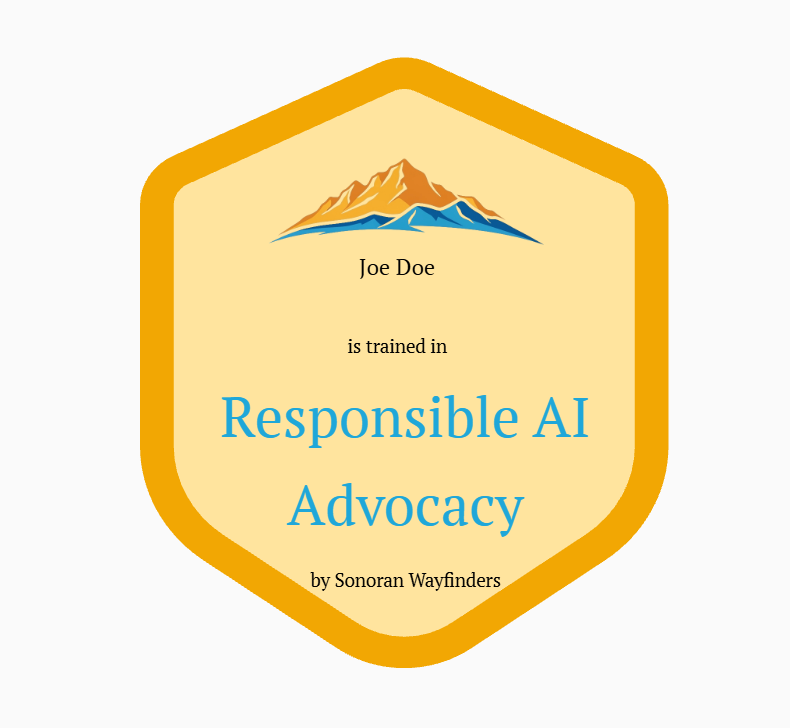
"Trained in Responsible AI Advocacy" Digital Badge
Upon passing the Phase IX competency check and course evaluation, you receive an independently verifiable digital badge powered by Certifier:
- Portability: Embed the badge directly into your LinkedIn licenses/certifications section, email signature, or practice website.
- Third-Party Verification: A permanent public link allowing clients and clinical partners to verify your training in safe AI sanitization.
- CE Certificate: Includes a downloadable PDF Certificate of Completion for 2.0 BCPA Contact Hours.
About Your Instructor
Renea Stasaski, MS, BCPA
Renea’s work sits at the intersection of Biomedical Engineering, regulatory compliance rigor, and Board Certified Patient Advocacy. Rather than theoretical hype, she focuses on building practical, defensible workflows that allow independent advocates to safely harness AI tools to reduce administrative burden without sacrificing client privacy or clinical ethics.
AI? Piece of Cake
Self-paced continuing education module for independent advocates
- Full access to interactive Notion-based course workspace
- Interactive Google Apps Script data redaction labs
- Privacy policy audit breakdowns for 4 major AI models
- Data de-identification protocols (Legal, Subtle, & JEDI)
- Verifiable Responsible AI Advocacy digital badge for LinkedIn/Web
- Certificate of Completion (2.0 PACB CE Hours approved)
- Permanent digital asset: duplicate into your own Notion account